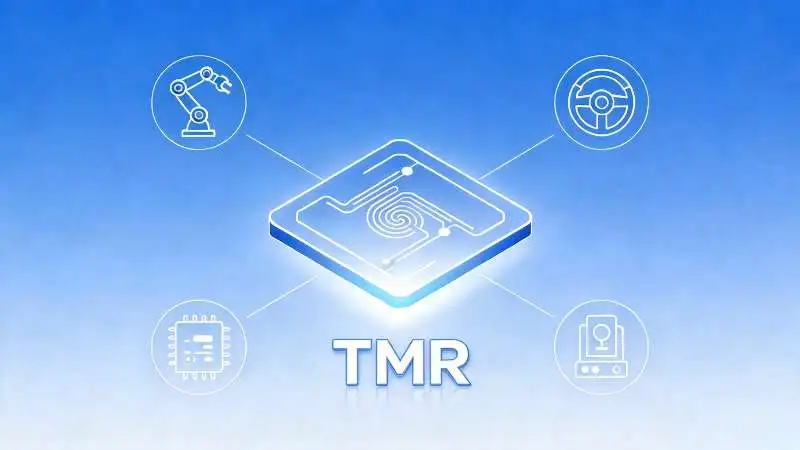
Background Introduction
Humanoid robots and intelligent equipment are entering a period of rapid development, and industrial automation and precision equipment continue to iterate, placing strict demands on the accuracy and stability of angle, position, and speed detection. As the core "perception terminal" of intelligent equipment, the performance limit of the encoder's sensing technology directly determines the detection accuracy, anti-interference ability, and operational reliability of the equipment, and is also the core standard for distinguishing between mid to high end precision encoders.
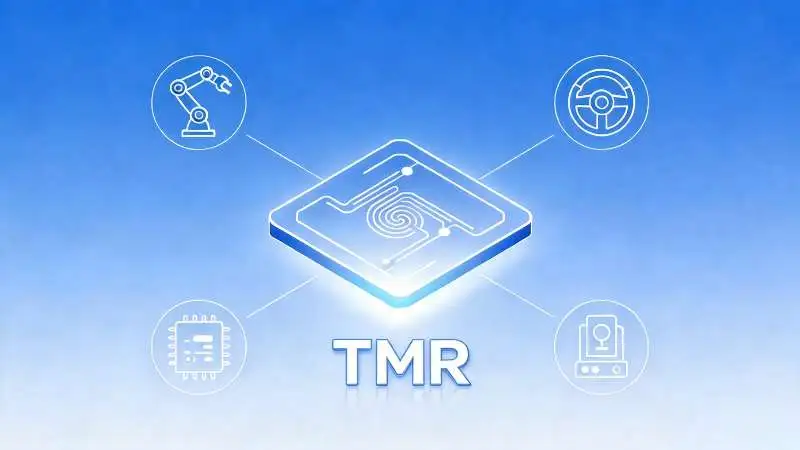
Wuxi Este Magnetic Technology Co., Ltd. (hereinafter referred to as "Este Magnetic" - Xici Technology Magnetic Encoder sub brand) has a high-precision magnetic encoder, and the entire series is equipped with TMR ultra high precision magnetic induction technology (tunnel magnetoresistance technology) as standard. Compared to the Hall scheme, TMR relies on the cutting-edge quantum tunneling effect and has core advantages such as high sensitivity, low noise, excellent linearity, and low temperature drift. It can accurately capture weak magnetic fields and achieve ultra-high resolution detection. At the same time, it can perfectly adapt to complex industrial working conditions and achieve comprehensive upgrades in terms of operational stability, anti-interference, and low power consumption.
Bottom level logic: TMR originated from spintronics, which laid the foundation for the 2007 Nobel Prize
1. 2007 Nobel Prize in Physics: The disciplinary starting point of spintronics
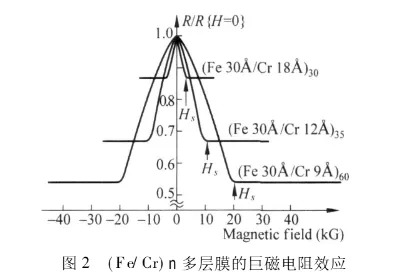
The 2007 Nobel Prize in Physics was awarded to Albert Fert and Peter Gr ü nberg in recognition of their independent discovery of the GMR giant magnetoresistance effect.
This discovery officially pioneered spintronics, breaking the technological limitations of traditional electronics that only utilize electronic charges. For the first time, it achieved the controllable control of electron spin to change device resistance, establishing a complete physical framework for electron spin transport and laying a theoretical foundation for the next generation of magneto electric devices.
Traditional electronics only manipulate electronic charges to achieve signal transmission;
Spintronics synchronously utilizes the dual quantum properties of electron charge and spin, making electron spin a new carrier for signal perception and data storage.
2. The relationship between TMR, spintronics, and GMR technology
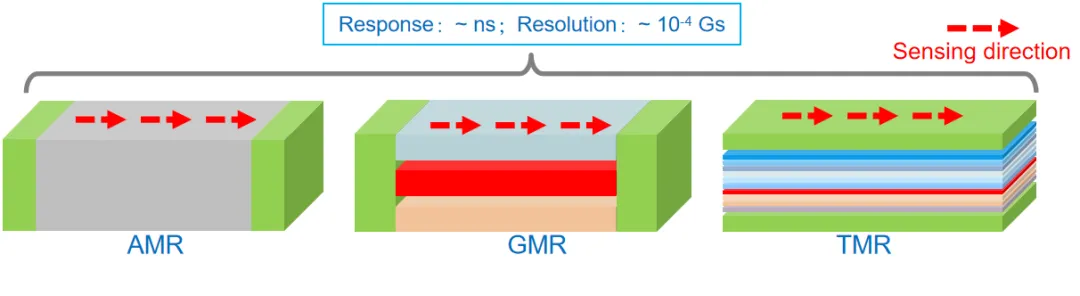
TMR tunneling magnetoresistance technology is a high-performance iterative upgraded version of GMR giant magnetoresistance technology in the spintronics system. The two share the same origin and technology, but the performance gap is significant.
GMR sandwich structure: using ferromagnetic layer and metal conductive isolation layer, relying on spin scattering to achieve resistance change, is the first commercial solution of spintronics;
TMR Magnetic Tunnel Junction (MTJ): Adopting a magnetic tunnel junction (MTJ) structure consisting of a ferromagnetic layer and a nano insulating barrier (MgO), it operates through the electron spin polarized quantum tunneling effect, fully inheriting the core physical mechanism of spintronics. At the same time, it achieves a leapfrog improvement in magnetic resistivity, detection sensitivity, and stability, surpassing GMR comprehensively.
In short, the 2007 Nobel Prize in GMR technology opened the commercial door for spintronics, and TMR is the core mature branch of spintronics towards high-end industrialization.
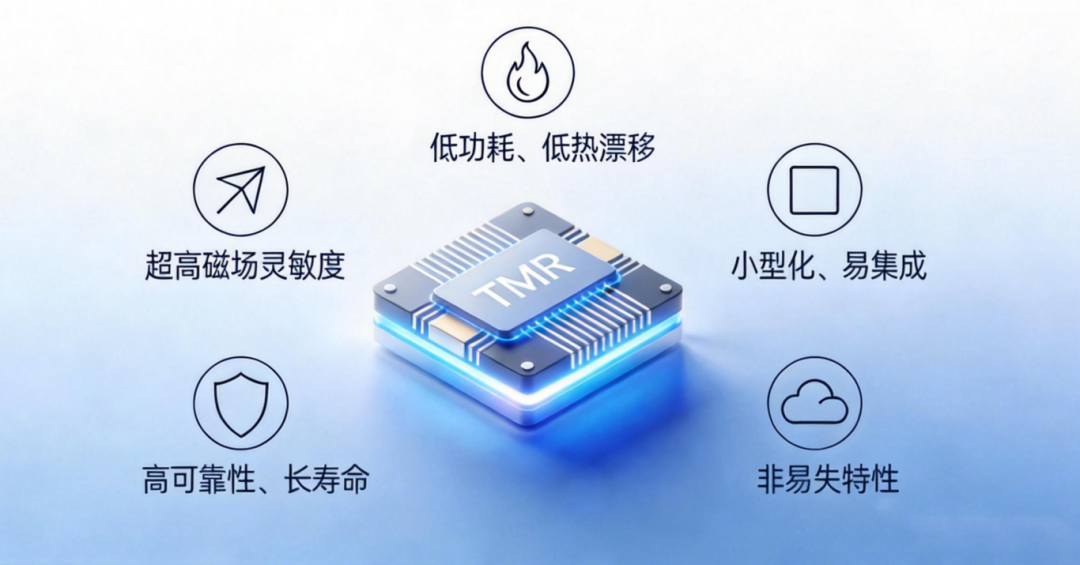
Core advantage: TMR devices directly inherit the inherent advantages of spintronics
1. Ultra high magnetic field sensitivity
With the spin tunneling effect, the TMR magnetoresistance can reach 100%~1000%, and a weak magnetic field can generate a large resistance difference. The detection resolution and accuracy far exceed traditional solutions such as AMR and ordinary GMR, perfectly adapting to high-precision angle, position, and current detection scenarios.
2. Low power consumption, low thermal drift
The device operates based on tunneling effect, resulting in lower driving current; Paired with MgO insulation barrier structure, it has a small temperature coefficient and excellent temperature drift controllability, and can still output stable and accurate signals in extreme industrial environments at high and low temperatures.
3. Miniaturization and easy integration
Adopting nano thin film technology, it is compatible with wafer level CMOS packaging, with a compact chip size that can be widely adapted to compact and precise equipment such as robot joints, vehicle electronic control, and micro sensing modules.
4. High reliability and long lifespan
No mechanical wear and no attenuation of optical components; The number of read and write cycles far exceeds that of conventional devices, while possessing strong seismic and dust resistance capabilities, suitable for harsh and complex working conditions such as industrial automation and vehicle mounted applications.
5. Non volatile characteristics, expanding storage applications
The spin magnetization state is not lost when powered off, and the MRAM storage chip derived from this characteristic has the triple advantages of high-speed read and write, infinite erase and write, and power-off data protection. It is a new generation of high-end storage core solution.
Global Implementation: The Wide Application of TMR Spintronics Technology
1. High precision magnetic sensing (core main track)
Industrial field: Precision measurement and control scenarios such as joint absolute encoders for humanoid/collaborative robots, high-precision turntables, servo motor angle detection, and water pump flow sensing;
In the automotive field, vehicle mounted electronic control systems such as motor position sensing, current detection, and steering wheel angle sensing are used;
Instrument field: smart meters, flow sensors, high-precision displacement/angle detection modules.
2. Next generation storage MRAM
Relying on the core structure of TMR tunnel junction, it can replace traditional Flash and SRAM storage chips and is widely used in servers, vehicle controllers, and industrial embedded chips, solving the industry pain points of short flash memory erase life and data loss due to power outages.
3. Iterative upgrading of information storage industry
Since the 1990s, GMR read heads have significantly increased storage density;
Since 2006, high-end hard drives have been fully iterated into TMR read heads, with performance and stability upgrades, making it one of the more mature landing applications of spintronics.
4. Frontier field expansion
At present, TMR technology has expanded to cutting-edge fields such as radio frequency detection, brain like computing, aerospace radiation resistant chips, and high-end medical magnetic detection equipment, and its technological potential continues to be released.
Este Magnetic Technology (a sub brand of Xici Technology's magnetic encoders) is equipped with TMR tunnel magnetoresistance sensing technology for its entire range of high-precision magnetic encoders, providing stable angle and position feedback for robots, servo drives, and precision automation equipment. If you have any questions about encoder selection and working condition adaptation, please feel free to communicate with our technical team.